Tuesday, June 05, 2007

Working Webcomics

I've been reading The Devil's Panties, and I keep thinking about something that comic's writer, Jennie Breeden says in her FAQ (under "What advice would you give to someone who wants to do webcomics?") It is making me think that webcomics are getting more established, at least by one particular measurement.

First, some background. Here is a conversation I've had maybe a fourty times:


SOMEONE GETTING TO KNOW ME: What kind of books do you read?
ME: I read a lot of webcomics.

SGTKM: What's a webcomic?

ME: A webcomic is a comic strip that is published regularly on the internet, usually by an amateur artist. They are almost entirely different from the comics you'd read in a newspaper.


For one thing, with webcomics the reader can go back and all the comic strips that author has ever written from the beginning, which lets webcomics artists to do longer storylines. Some of those story lines go on for years.

For another, webcomics artists can get more and faster feedback from their fans. Some artists feel that what their fans think is important, some don't.

Finally, because webcomics artists don't have to answer to a syndicate or a boss or even really their fans, they can just do what they want, so there's a much richer range of subject matter and different types of people writing it. Webcomics can more easily explore adult themes and write for an adult audience.

SGTKM: Do these artists make money with their comics?

I used to say:
ME: Most don't. They do it to develop as an artist, or because they want to develop an audience for their art, or because they like doing the art anyway so they feel like they might as well let an audience see it, too.

A few have been around a long time and have built enough of an audience that they can quit their day jobs and earn a salary by selling merchandise through their websites, but you could count the comics like that on your fingers.


That brings me to my point. In her FAQ, Breeden lays out what aspiring webcomics artists can expect from in their first five years if they do it like she did it (promoting her comic at conventions, etc.)

This makes me think that webcomics artists are supporting themselves with their art more regularly than they did before. When I think about the artists who make the comics I read every day, that seems right.

That's it, just a small idea, but I think it's significant. It wasn't long ago that no one could have written about what to expect from your first five years because no one had actually done it.

Monday, June 04, 2007

Look Like ribble

T-shirts I wear. IN REAL TIME!

Divided by origin.

ATLANTA

Orange Atari

Rolling Bones Premium Pit BBQ

Superman (fuzzy)


SALVATION ARMY FAMILY STORES IN SAN ANTONIO, TX

HEB Snacks Summer 2004

Tri-City Softball / Donaho #3

Gruene Hall / Texas' Oldest Dance Hall

Front: "Generators." Sleeve: ("everyone wins when the turbine spins")

Southwestern Bell Pioneers Volunteers

LAPD

Bobcat Football / Hinojosa #89

Reuniendo a la Familia Southwestern Bell Long Distance

Whataburger A1 Thick & Hearty Burger

Peppercorn Ranch Whatachick'n Sandwich (for a limited time only)

Luther Burbank Vocational High School 30 Year Reunion 1971-2001

Jack Daniels Old #7


DUMBRELLA

The Flabergasted Eagle

Loch Ness Monster Adventure Club

Mix Tape

From Scary-Go-Round: Front: "Welcome to Robotania" Back: "Main export: dismay." (ret.)


OTHER WEBCOMICS

Virginia (Note: non-ironic version)

The Internet is a Series of Tubes (from Superosity, this shirt featured the Ted Stevens quote next to an 8-bit Mario on a tube.)


VARIOUS

Dartmouth Reinventing Earth Week

The Owl Bar & Cafe San Antonio, New Mexico (the internet has a surprisingly large amount of information on this place when you consider it's in THE MIDDLE OF NOWHERE.)

Front: Giant image of Sean Connery. Back (in courier: "The name's Bond. James Bond."

Harry's Roadhouse: "EAT. yum."

Front: "Ruprecht The Boy Wonder." Back: "World Tour 1987-2006," lists all nine places my current roommate has gone to school.

Front: Francis, State Highway Administration Maryland Arm patch: SHA Certified Heavy Equipment Operator Level III Label: SUi State Use Industries

Burmese alphabet

Sunday, June 03, 2007

ribble's Stock Responses

"These things happen."
"You should write an angry letter."
"I believe you."
"Sounds about right."
"Fair enough."
"So you say." / "So you claim."
"Just so we're on the same page here."

Also:
"Oh."
"All right."
"Okay."

Sure, it's trivial, but I've noticed that these change every six months or so and I'm interested in keeping track.

Saturday, June 02, 2007

'Tis the Season

It's finally summer, and in New York, that means it's five different seasons at once.

First of all, it's the hot season.

In San Antonio, heat and humidity meet you like a wall as soon as you get out of the airport, and I will maintain every day until my dying day that the heat in Texas is a lot worse than the heat here.

But San Antonio has a cooling infrastructure (central air, ceiling fans) that for whatever reason doesn't exist in The City. There's just better internal air movement down there.

As a result, and I noticed this for the first time the other week while helping my cousin the revolutionary in to his new place, I no longer even notice when I'm pouring sweat.


Second, it's smell season.

It doesn't stink in Texas for the simple reason that there are no people walking around on the streets down there unless they are walking to their car. People mean waste and waste means smell.

I've never found the stench unbearable, but I know people, even people who grew up here (Vickyheart comes to mind) who just can't take it anymore and occasionally have to run off to live in New Jersey or something equally absurd.

Third, it is roach season.

Roaches freak me out a lot less than they did when I first move to the city, but they're definitely the worst of the five things listed here.

I crushed my first roach of the summer on a subway platform this morning. The worst I've seen was on a turkey leg outside the construction on the west side of the Port Authority Bus Terminal.


My last roommate would flee the room and sometimes the whole apartment if she thought she even heard a roach.

Roaches are a good reason to keep a clean place. Mice are more manageable. I'm sort of hoping they come back now that I have a cat, but so far they've been too smart.

Fourth, it's real estate season. Everyone but everyone, from the cute little red-haired girl who lived down the street to My Cousin the Revolutionary to my friend Gigi, who is overjoyed to finally be escaping Jersey.

New Yorkers love love love talking real estate. This Park Slope Reader guide to Park Slope blogs [PDF] has four categories: food, real estate, literary arts and kids. That's my neighborhoods priorities in a nutshell.

By the way, if you are interested in a two-bedroom in a small building in Prospect Heights for about $2000 a month, and you are cool, my email address is on the top right there.


Finally, it's tourist season. Even in Texas, people always assumed I was a New Yorker even when I wasn't, but it didn't take long for me to be able to spot the visitors on any subway platform, public park or street corner.

It takes maybe three months to understand comprehensively how to move in this city (layout, busses, rush hour, etc.), so the easiest spots to pick out tourists are sidewalks and subways.

They have to talk a lot about how to get where they're going, travel in groups that always look similar to each other, often seem travel weary because they don't tend to find the time to just sit down, and have a mildly annoying habit of just stopping in awkward places that make it difficult to walk around them.

Tourists also look different from New Yorkers, who are slimmer then most Americans just because we walk everywhere.

I don't want to sound anti-tourist because I know it's an important part of the city and brings in money, but if I am anti-tourist, I come by it honestly.

I grew up in the King William District of San Antonio, a big tourist destination for a big tourist city, and I lived in a front bedroom facing the street. Tour busses came by every hour or so. As I result, I spent my entire childhood paranoid behind closed bedroom shades.

I realize New York must sound pretty bad, infested as it is by heat, smells, roaches and tourists. The fact is, New York is always gorgeous as long as it's not obscenely cold. There is no place I'd rather be.

Friday, June 01, 2007

San Antonio Spurs: Manu Ginobili

When people talk about the three superstars of the San Antonio Spurs, they are talking about Tim Duncan, Tony Parker and Manu Ginobili.

When Ginobili drives to the basket, his limbs fly everywhere and he always seems like he's about to lose control, but somehow in there he manages to get to the basket, take a good shot or draw a foul. It's a little like watching a bowl of spaghetti while someone shakes it.

Spurs Head Coach Gregg Popovich has said he doesn't try to coach Ginobili, but I think that's just his way of saying he doesn't understand how Ginobili plays. Part of that is that Ginobili is Argentinian.

Now, at my odd and obscure international school in Wales, I felt like I developed a pretty good sense of different countries' national identities.

Although each of the 300-odd students at my school was different from the others, when I put all the people from a particular country together, I could usually see a single thing they all had in common, like how Americans have this overwhelming sense of the power of the individual.


Not to oversimplify, but the Argentinians were all weird. They were funny, they had a lot of energy, and even with the introverted ones, you felt like there was at least part of their brain that was going 100 miles a minute.

I got along pretty well with the Argentinians at my school, and when I think about them, the way Ginobili plays makes a lot of sense.

Ginobili (who, as I understand, is a national superstar), comes from the only basketball town in what is, of course, a football country (although I don't know whether this led to Ginobili's prowess or the other way around.)

In fact, and this is one of my favorite things about Ginobili, he led Argentina to a gold medal in the last summer Olympics. Isn't that great? It's as if Alexander the Great conquered the world and then came back to my hometown to be my lieutenant in a regular Warhammer 40,000 game.

Ginobili is a part of why the Spurs are such a strong road team because he doesn't mind being the villain on the road.


He hasn't really taken off during any particular game in these playoffs, but I remember last year he went to Denver and just humiliated the Nuggets during that series. He is still booed there.

I would also be remiss if I didn't mention that he is one of the league's best floppers, which I always find mildly embarrassing. Apparently one of his team nicknames is "El Contusion" because of how he lets himself get banged up during a game.

The one thing I know I don't understand about Ginobili is why he plays so well off the bench. Ginobili, basically a starter, has played on and off for years as the sixth man.

Maybe it's a Seabiscuit thing, like he needs to be a little behind at the last turn to push himself for the finish.

Or maybe it's that Ginobili, one of the most entertaining and energetic players in the league, brings that shot of energy and enthusiasm to the Spurs just when they need it to be a championship team.

Thursday, May 31, 2007

Random Access Culture

Alternate Title:
Schoolhouse Rock [Slash] The World as We Know It

About eight months ago, I was hanging out with some of my cousin the revolutionary's friends when the conversation turned to Schoolhouse Rock.

"Have you watched them?" Codename Judy asked a friend. "They're musicals about things like conjunctions, or how a bill becomes a law. They're really funny. You should take a look."

I realized that Codename Judy was talking about YouTube.

Now, my cousin graduated this month, three years after I graduated. In demographic terms, that makes us both upstanding members of Generation Y, but, in college terms, that puts my cousin and his friends about a generation away from me. Which is to say, MCTR spent the majority of his college years in a post-YouTube world, and I spent the majority of mine in a pre-YouTube world.


A sociological rule of thumb is that technology invented before you were a certain age is commonplace and to be taken for granted, technology invented in your adult life is kind of cool and something you may be able to make a living at, and technology invented later in your life is foreign, alien, not to be trusted and certainly not worth understanding.

I had one of my post-take-it-for-granted moments during this conversation.

Schoolhouse Rock is plausibly timeless in that it's catchy or educational no matter when you watch it, but ultimately it's a very iconic relic of the 1970s.

Up until now that meant that you had to either live through the '70s or go out of your way to watch Schoolhouse Rock. Now, you can watch it any time. Go ahead. It's right here.


Of course, it's not just Schoolhouse Rock. For the first time in history, we can experience the detritus (or at least the recorded television detritus) of any previous culture at any time. Which would mean I just went a long way to demonstrate a very simple point if it weren't for this fact's odd and far-reaching implications.


Like We Even Needed Another Victory For Postmodernism

I took a U.S. television history course at my high-pedigree school and we had a section on post-modernism.

For those of you who haven't been to college (or who have been to college but somehow avoided the idea of post-modernism, presumably by taking a lot of bio classes), postmodernism is the idea that in the present day, there is somehow so much information that we can't reliably run down a definition of anything. Or that there's so much change in the modern day that in a way you can't expect anything to go unchanged. Or it's a breakdown between the signifier and the signified. Or it's something else.

There's a million definitions of postmodernism (which is one of the most post-modern things about it, as my professor was fond of saying without irony). In television history, it's significant because no two people ever have the same experience with television, so there's no common understanding of what it is, or what it means, or its history.


Obviously, YouTube has some important implications here beyond the citizen journalism stuff you can go explore somewhere else, because for the first time we can access these obscure or outdated things whenever we want.

It's a direction television has been moving towards for awhile (rise of DVRs, etc.) I don't want to go in to it too much because there is, by definition, no end to how far you can take the idea of an increasingly postmodern world.


Culture as a Tap and Not a Resevoir

If everyone can access different aspects of culture at any time, maybe we need to think about culture differently, as more of a utility and less as a resource.

Take jokes. In the past, if someone (a comedian, say) made a reference to something, you either got it or you didn't. Humor was time and culture sensitive.


It still is, but now, if we hear a reference we don't understand, we can just google it. We might not get a joke quick enough to laugh, but we may get it the next time.

Take, for example, John McCain's comment (in a blogger conference call, significantly) that his Republican primary opponent Mitch Romney’s immigration plan might be to “get out his small-varmint gun and drive those Guatemalans off his yard."

I was watching Stephanopoulos, and a panelist pointed out that the brilliance of that comment was that in referenced no less than two Romney campaign flaps in addition to his the actual point about immigration, leading everyone who talks about the comment to also explain those references in full and so spend a lot more time talking about Romney's problems than McCain had to.

Remember how I was talking last week about how eidetic memory is the ultimate modern superpower? Maybe we don't really need it.


In the imminent future when all Americans can google whatever they want from their personal cell phones, what's the point of retaining information at all? Information changes all the time. What the best schools have already learned is that they need to teach understanding, techniques for learning, and a way to evaluate the relative value information much more than they need to convey the information itself.

It's one difference I also notice between my generation and older ones. We seem to have an almost instinctual understanding of the kind of information on the internet.

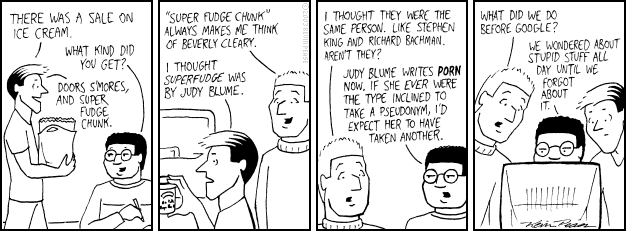
It isn't instinct, of course, it's experience - we search casually all the time - but I'm so conditioned to it that it's strange to watch my parents look for information without the internet. It's like another world - a world before google. [via Absurd Notions]


Brangelina: Another Drawback to Random Access

Another weird thing is that there's also a leak factor here. Random access means that bullshit information is written right next to good information, and that characteristic holds true just as well for culture as it does for computers.


Example: around when Teti lambasted me for not knowing offhand the definition of DRM, I just some stupid idea that I ought to be reading the big blogs. Anyway, as a New Yorker, I decided one of the significant ones was Gawker.

Anyway, after a few months, I just had to give Gawker up. I had been trying to figure out why I knew more celebrity gossip than I had at any previous time in my life, and I realized as I clicked back through whatever the hell was going on with Lindsay Lohan at the time that Gawker was probably why.

I was never trying to seek out information on celebrity marriages. I was casually following some series of references and it just happened to me. I still feel like I can't get away from it - I know that Brad is having trouble with Angelina. It's just that this useless, waste of time information is sandwiched next to the good information, like the copy of The Economist next to US Weekly at a newsstand.


I Am Next to You

Okay, I'm coming up on my last point, and it involves a little geography lesson.


Manhattan is an island. Horizontal space is limited. This means that, where in a city like San Antonio, we would build out in to ever-expanding borders, in New York everyone built up.

As a result, New York has always had a lot of people living in a geographically small space that was easy to get around. This led to a thriving regional specialty in all things niche.

Let's say that one in 1,000 people is interested in anime in 1995. In San Antonio (pop. 1,000,000), that's 1,000 people spread all over the city. In New York (pop. 8,000,000), there's not only 7,000 more people interested in anime, they are in a much smaller geographical area, and it's much easier for them to get to an anime store.

So when I came to New York for one of the first times to visit my friend Josh, he introduced me to a bunch of anime that it turned out was really interesting, and which I never would have heard about if it wasn't for my trip to the city.


By concentrating a large market on an island, New York allowed specialty vendors to thrive - which helped increase interest, which spurred the sellers, etc.

Result: New York has consistently been one of the few places in the world where you can pretty much buy anything at any price. And, more than that, it concentrated a community of like-minded people in to a space where they had greater access to each other.

The point is that the internet has lowered our barriers to entry to particular cultures or interests to just time and search capabilities. The niche thrives on the internet. We can find support for a particular cause, like-minded people or markets for niche products almost without any effort.

Random Access ribbles
Whenever I get to the end of one of my Big, Long Essays That Take Forever to Write I feel like I've taken a lot of trouble to explain something very simple.


There would be no way to give this kind of an explanation without the internet - just look at the number of links in this post alone. I'd still be thinking about these things, but the reason I like this medium so much is that I don't have to explain all my references, ideas and examples completely because I can just link to the appropriate information.

In a way (and once again, this is by no means a new idea) this means that we each have access to an entirely new medium to express ourselves. But it also means that there is no end to the depths of the trivial we can explore (for example, after this I fully intend to write about either Manu Ginobili, the weather or my cat.)

It would be one thing if I were spurring the country to a new national debate, but I suspect no one reads these things, but Johnny took his blog, arguably just a series of rants on National Ice-cream Day, and turned it in to a job at The Daily Show, so maybe there's hope for me yet.

Maybe I should send Gawker a resume...

Wednesday, May 30, 2007

Trope

I've been reading the TV Tropes Wiki. I don't know what to say except that it is so obviously my sort of thing. Once I feel satiated, I might try to find a place there for some of my clearer media-obsessed ideas.